Why Dropbox and Consumer Cloud Drives Fail Construction Projects and What to Do About It

Data is the lifeblood of every construction project. Surveying datasets, BIM models, CAD files, and geospatial data are the foundation of modern infrastructure delivery. In fact, according to Egnyte’s Architecture, Engineering, and Construction Data Insights Report, the average storage per AEC customer nearly quadrupled from 0.9 TB in 2017 to 3.5 TB in 2021, (≈31.2% CAGR) (1). It goes to show that the stakes have never been higher.
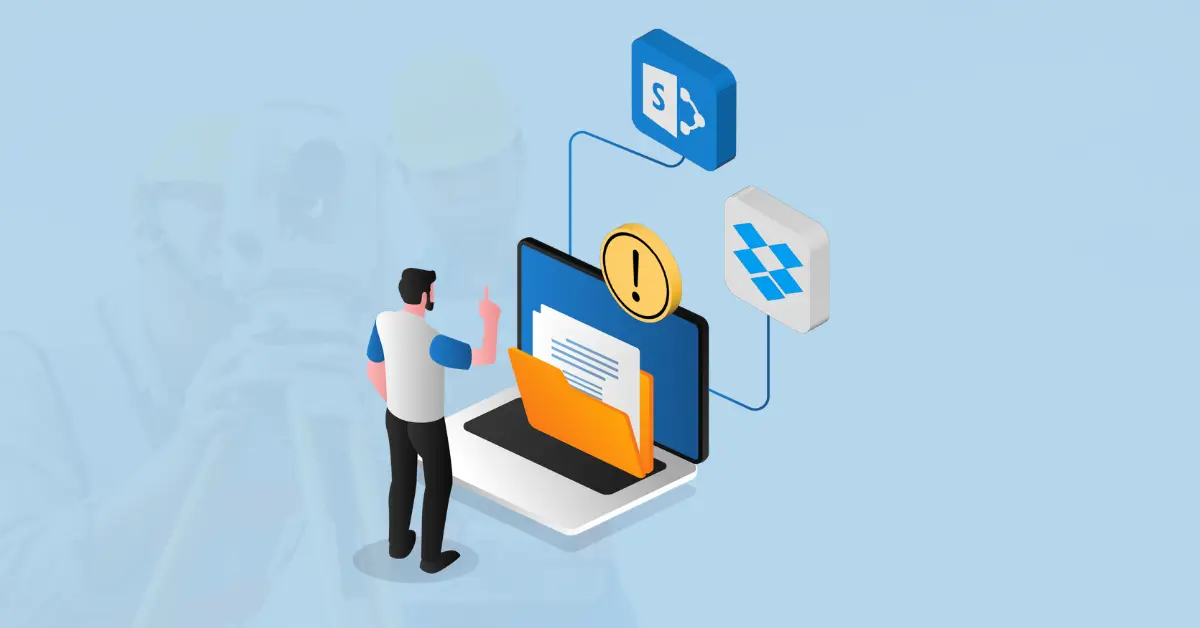
For many teams today, the challenge is still relying on consumer cloud products — Dropbox, OneDrive, Google Drive, and SharePoint — to manage mission-critical information.
On the surface, these tools seem attractive: they’re cheap, easy to use, and widely available. But beneath the convenience lie hidden risks that threaten project integrity, profitability, and collaboration. They may be easy to get up and running, but when it comes to functionality, they are shortsighted for engineering and construction professionals.
This guide explores why consumer-grade cloud storage isn’t built for Engineering and Construction, the pitfalls real teams face, and why more firms are adopting connected, data-agnostic Common Data Environments (CDEs) like 12d Synergy.
The AEC Industry’s Data Revolution
When looking at data in the engineering and construction industry, what was once a fragmented, manual, and inefficient process is becoming smarter, faster, and more connected. The industry is experiencing unprecedented digital transformation, driven by several key factors:
- Exponential Data Growth: Projects now generate massive datasets from laser scanning, drone surveys, IoT sensors, and advanced modeling.
- Digital Twin Integration: Strategic use of data from Digital Twins can reduce operating expenses by up to 35%.
- AI and Machine Learning: AI and ML are increasingly being used as part of data management in construction to analyze vast amounts of data to power predictive analytics.
- Regulatory Compliance: IT security regulations like ISO 270001 and ISO 19650 mandates and digital engineering requirements demand structured, traceable data management.
The Problem: Consumer Clouds Were Never Built for AEC
When managing data keeping in mind the requirements of the
Dropbox, Google Drive, and OneDrive were designed for simple, office-style file sharing — Word documents, PDFs, maybe a few spreadsheets.
AEC projects are different. They require:
- Massive datasets (terabytes of survey and model data)
- Complex, interrelated file structures (managed folders with thousands of linked files)
- Strict version control and auditability (to meet compliance and reduce rework)
- Multi-user access at scale (dozens of engineers, surveyors, and contractors working in parallel)
- Security-minded information management as required by ISO 19650-5 standards
Generic cloud platforms simply weren’t built for this. As Lincoln Smith, Digital Enginuiti put it:
“Dropbox can’t comprehend the fact that you’ve got a folder full of thousands of interrelated files. It treats everything as standalone and that’s a recipe for data corruption.”
Common Pitfalls of Dropbox and Consumer Cloud Solutions
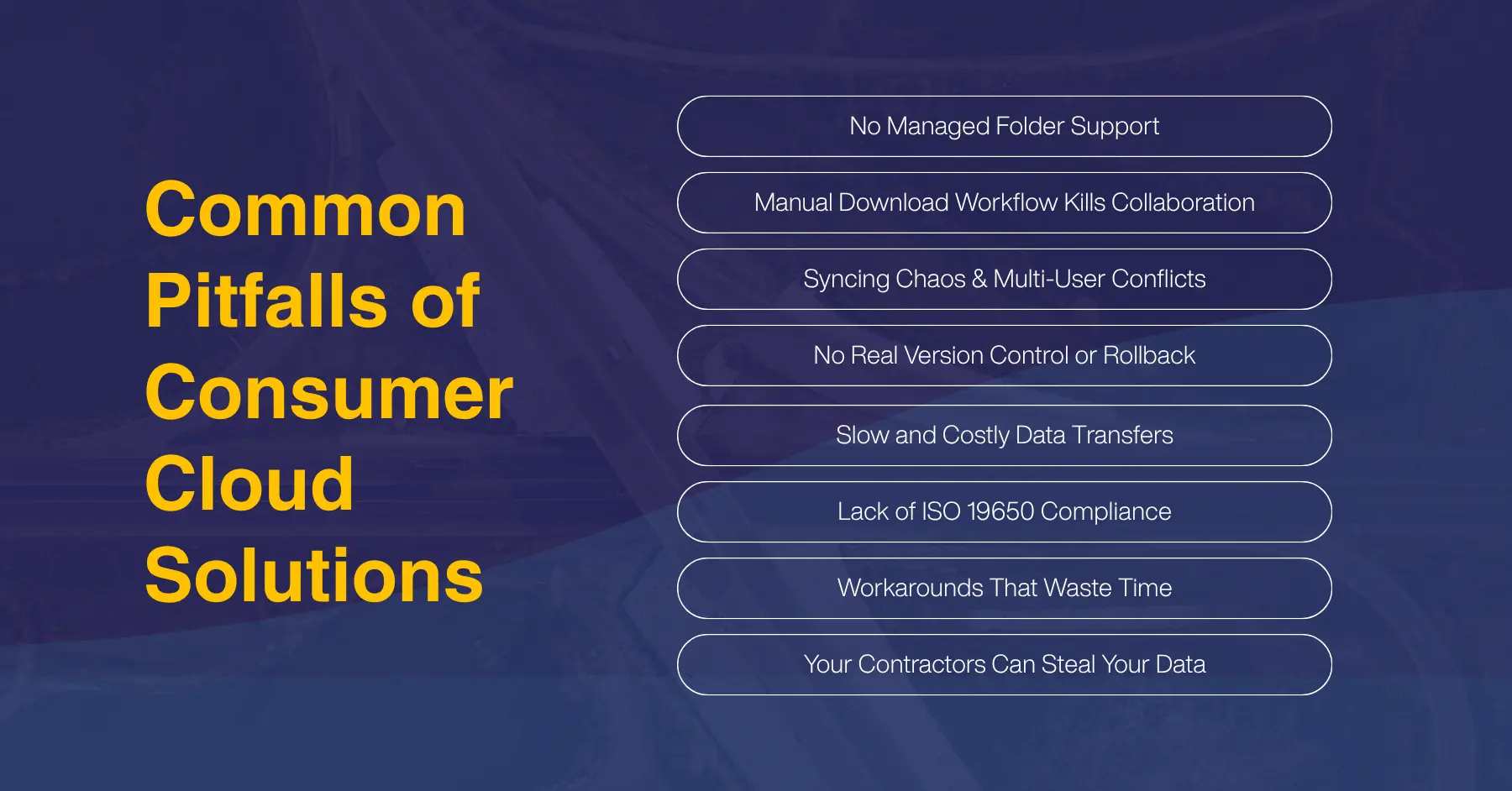
Here are the challenges that appear again and again across AEC teams trying to “make do” with generic cloud tools:
1. No Managed Folder Support
Consumer cloud tools treat every file as an isolated object, but construction projects are much more than a collection of files; they’re structured environments with interdependent data. In construction, files often rely on dependencies: linked CAD drawings, external references, or datasets spread across multiple folders. Without proper managed folder support, the relationships between these files are easily broken.
Downloading or syncing files individually can lead to missing dependencies, broken references, or corrupted models, increasing rework and risk. A solution that understands and preserves these file dependencies ensures that project data stays intact, accurate, and usable.
2. Manual Download Workflow Kills Collaboration
Consumer cloud solutions are built around a fundamentally flawed workflow: manual download and upload. Users must:
- Download files to their local machine
- Work in isolation
- Manually upload changes back to the cloud
- Hope no one else was working on the same files
This manual process destroys real-time collaboration. While one team member works on downloaded files, others can’t see progress, make coordinated changes, or even know what’s being modified. Projects stall as teams wait for the “file owner” to finish their work and re-upload.
3. Syncing Chaos & Multi-User Conflicts
When teams try to bypass manual downloads with sync folders, new problems emerge. Two users sync a project at once. Both make changes. Dropbox tries to merge them. The result? Duplicated files, overwritten data, or missing records. There’s no proactive check-in/check-out process to prevent conflicts.
Consumer cloud sync wasn’t designed for the complex, interconnected file structures common in AEC projects. When sync conflicts occur in a folder containing thousands of interrelated CAD references, survey data, and model files, the corruption can cascade throughout the entire project structure.
As one surveyor told our support team, “It was fine with three people, but as soon as we grew to eight users, things went wonky. Files disappeared, corruption increased, and version control went out the window.”
4. No Real Version Control or Rollback
Most consumer clouds keep basic file history, but not true project version control. You can’t rollback a multi-file dataset to a trusted state. In AEC, that means costly rework and compliance risks.
5. Slow and Costly Data Transfers
Geospatial datasets, laser scans, and models can be tens of gigabytes. Dropbox re-syncs entire folders, wasting time and bandwidth. AEC teams need intelligent, delta-based transfers that only move what’s changed.
6. Lack of ISO 19650 Compliance
ISO 19650 is an international standard for managing information over the entire lifecycle of a built asset using BIM. Consumer clouds lack the structured information management framework required for:
- Common Data Environment (CDE) workflows
- Proper information containers and naming conventions
- Security-minded information handling
- Audit trails and accountability
7. Workarounds That Waste Time
Teams often resort to “zipping projects” to avoid corruption. This adds hours of manual work, creates duplicate data, and relies on perfect team communication. In practice, it rarely works.
8. Your Contractors Can Steal Your Data
Construction projects rely on sensitive, high-value data: survey setups, configuration files, quote templates, bid terms, and more. In traditional consumer-grade file storage, any contractor with access, even for a short-term project, can copy or download these assets and potentially use them with a competitor.
A classic scenario: a contractor joins the survey team for three months, takes all their critical project files, and later leverages that knowledge with a rival firm. Without robust access controls, permissions, and audit trails, your project’s intellectual property and competitive advantage are at serious risk.
The Hidden Costs of Consumer Cloud “Solutions”
While Dropbox may seem cost-effective, the hidden expenses add up:
- Rework costs: Data corruption leads to rebuilding models and surveys
- Project delays: Sync conflicts and file recovery slow progress
- Staff productivity loss: Teams spend hours on manual workarounds
- Compliance risks: Lack of audit trails can expose firms to legal liability
- Client dissatisfaction: Data integrity issues damage professional reputation
Why AEC Professionals Need a Purpose-Built, Data-Agnostic Solution
Instead of patching over Dropbox’s shortcomings with workarounds, AEC teams need tools built specifically for their workflows. A data-agnostic, construction-focused CDE delivers:
- Managed Folders: Keep entire project structures intact and protected
- Multi-User Access Controls: Check-in/check-out prevents overwrites and alerts teams who’s working on what
- Version Control & Rollback: Complete audit trail for compliance and QA
- Optimized Data Transfers: Move only what’s changed, not whole projects
- Cross-Disciplinary Support: Handle BIM, CAD, GIS, survey, and office files seamlessly
- Connected CDE Capabilities: Ensure a single source of truth across disciplines, software platforms, and project stages
- ISO 19650 Compliance: Meet international standards for information management
- Security Framework: Protect sensitive project information according to industry best practice

Futureproofing Your Data Management
The trends shaping 2025 like AI-driven automation, digital twins, modular construction, and cloud-based workflows aren’t just innovations; they are completely reshaping the DNA of AEC. To remain competitive, firms need data management solutions that can:
- Integrate with AI and machine learning tools for predictive analytics
- Support digital twin workflows and real-time data synchronization
- Scale seamlessly as project complexity increases
- Adapt to emerging technologies and industry standards
Dropbox vs. 12d Synergy: Key Differences
| Feature | Consumer Clouds | 12d Synergy |
| Built For | Personal and office file sharing | AEC professionals and large project datasets |
| Managed Folders | Not supported, prone to corruption | Full support with check-in/check-out & rollback |
| File Dependencies | Files are treated individually; linked CAD Xrefs, external references, and dependent datasets often break when downloaded or moved. | Automatically preserves all file relationships—CAD Xrefs, external references, and dependencies stay intact across moves, downloads, and shares. |
| Multi-User Access | Risk of overwrites and duplication. | Robust check-in/check-out and user notifications |
| Version Control | Limited, file-level only | Granular project versioning & full audit trail |
| Data Transfers | Full re-syncs, slow & bandwidth-heavy | Delta-sync, compressed, intelligent transfers |
| Large Files (BIM/Survey) | Struggles with gigabyte-scale datasets | Optimised for CAD, 12d Model, GIS & BIM data |
| Compliance | No ISO 19650 support | Designed for QA, legal traceability & ISO workflows |
| Security | Basic file-level security | Security-minded approach per ISO 19650-5 |
| Support | Generic, non-AEC | Industry-specific support from AEC experts |
| Sync Reliability | Prone to conflicts and corruption in complex file structures | Intelligent sync designed for interconnected AEC data |
| Integration |
Limited to basic file sync | Connected CDE with cross-platform compatibility |
Real-World Example: NorthConnex
NorthConnex, a $3 billion infrastructure project in NSW, Australia used 12d Synergy to manage 4 terabytes of data across 880,000 files. Over the life of the project, the system tracked 1.6 million file changes.
For an 8.2 GB project in size it had 65,000 elements and 900,000 points – which took 13 minutes to download (in office). This timing could be utilised productively elsewhere. Out on site, the timings were much worse with the limited bandwidth. To combat this, the attributes were exported to files on the server and replaced with a link to a file within a secure location.
12d Synergy was selected as the collaboration tool for the NorthConnex project. With the powerful common data environment in place, the team were able to store 880,000 files, hold 12d Model projects that were up to 9.8 GB in size and make 1.6 million file changes equalling to 3.9 TB.
As a result, the project size was reduced significantly with this new process.
Managing that scale on Dropbox? Impossible.
Industry Recognition and Market Growth
The shift toward specialized AEC data management is gaining momentum. The global architectural, engineering, and construction services market size was estimated at USD 108.15 billion in 2023 and is projected to reach USD 263.77 billion by 2030, growing at a CAGR of 14.5% (2). This growth is driving demand for sophisticated data management solutions that can handle the increasing complexity of modern projects.
Why Teams “Stick With” Dropbox (and Why That’s Changing)
Many small firms tolerate Dropbox or OneDrive because they’re cheap, often free, and “good enough” when only two or three people are working.
But as soon as teams scale, the cracks appear. The cost of errors, rework, and inefficiency far outweighs the subscription price of a purpose-built CDE.
AEC is moving toward connected, data-centric delivery models. ISO 19650 and digital engineering mandates demand structured, traceable data. Dropbox simply isn’t up to the task.
Making the Transition: What to Expect
Moving from consumer cloud storage to a professional CDE like 12d Synergy involves:
- Assessment Phase: Evaluate current data volumes, user count, and workflow requirements
- Migration Planning: Develop a structured approach to transfer existing project data
- Team Training: Ensure all users understand new workflows and best practices
- Gradual Rollout: Implement the CDE on new projects first, then migrate critical ongoing work
- Performance Monitoring: Track improvements in data integrity, collaboration efficiency, and compliance
Already Have a CDE? You’re Ahead of the Game
If your firm already uses a CDE, you understand the limitations of consumer clouds. But not all CDEs are created equal. Many first-generation solutions focus on basic file management without the connected, data-agnostic capabilities modern AEC projects demand.
Features like intelligent delta-sync, cross-platform integration, and true project-level version control separate next-generation CDEs from basic file repositories. If your current CDE feels more like “fancy Dropbox” than a true collaborative environment, it might be time to evaluate what modern solutions can offer.
Are You Ready for a CDE?
If you’re experiencing any of these challenges, it may be time to consider a Connected CDE:
- Corrupted projects requiring rework
- Duplicate files causing confusion
- Slow data transfers impacting productivity
- Version confusion leading to errors
- Compliance concerns with current workflows
- Team scaling challenges
- Integration difficulties with design software
12d Synergy offers:
- A safer, more efficient way to manage construction data
- Features designed for the way surveyors, engineers, and designers actually work
- The confidence that your data is accurate, secure, and compliant
- Future-ready data-agnostic solution that scales with industry evolution
Click here to take our quick CDE Readiness Check. Find out if your business is ready to move beyond Dropbox and adopt a solution built for the AEC industry.
It’s Time to be Future Ready
Consumer cloud platforms have their place but managing complex construction data isn’t it.
As projects grow in size and complexity, the risks of Dropbox and OneDrive compound. With data volumes continuing to grow exponentially and industry standards becoming more stringent, the window for relying on consumer-grade solutions is closing.
A purpose-built, data-agnostic CDE like 12d Synergy ensures your data remains accurate, accessible, and auditable so your teams can focus on delivering projects, not fixing broken files.
The question isn’t whether your firm will eventually need a professional data management solution. The question is whether you’ll make the transition proactively or wait until data disasters force your hand.
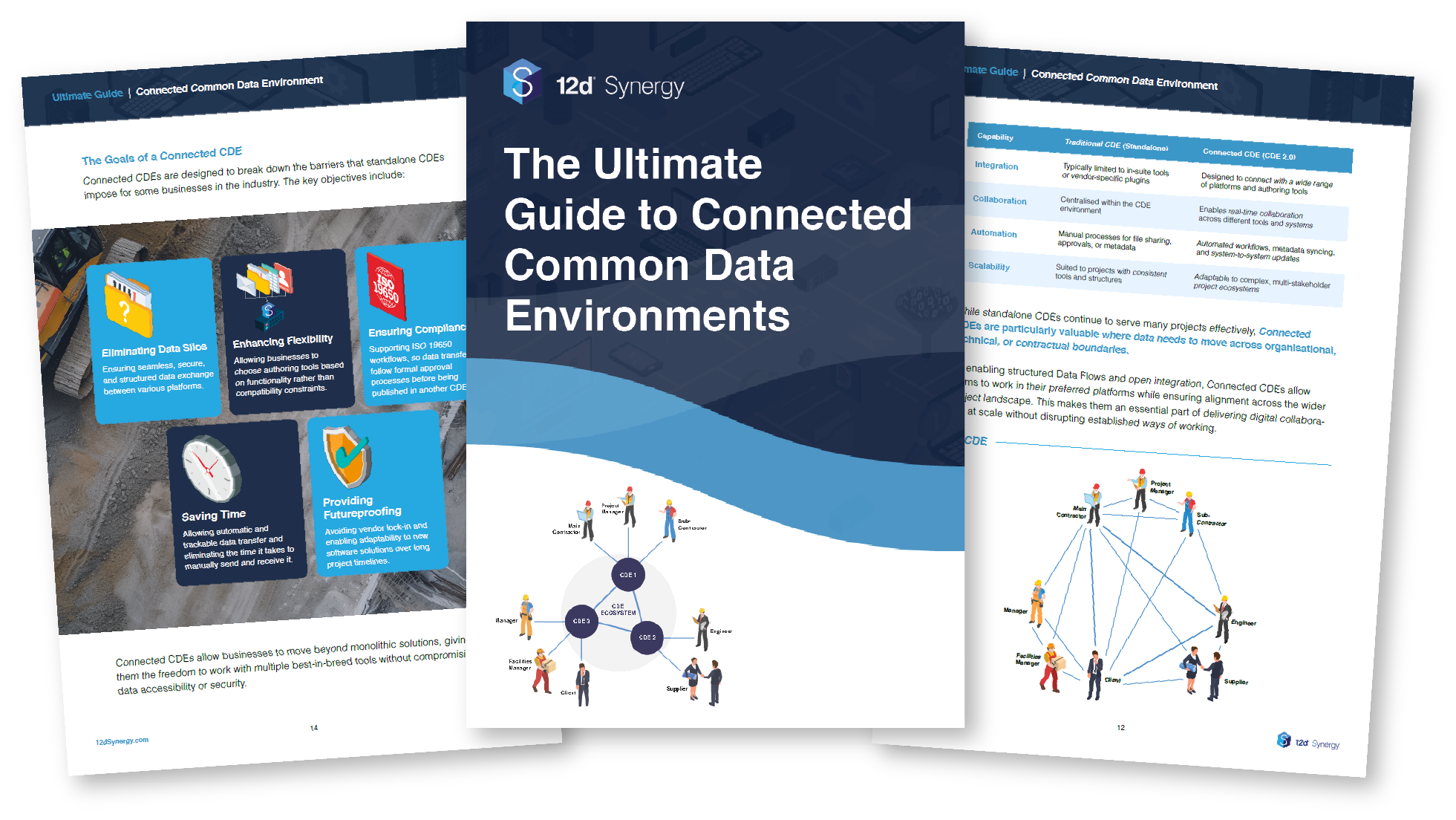
Download the Ultimate Guide to Connected CDEs eBook!
Complete the form below to download our in-depth eBook and share it with your team to explore how Connected CDEs can transform your data workflows—when it suits you.