How to Reduce Rework on Infrastructure Projects of Every Size
Every infrastructure project has access to more digital tools than ever. Yet rework, delays, and coordination problems persist. The issue usually isn’t the technology; but whether that technology is actually helping teams make better decisions.
Make project information easier to manage with 12d Synergy.
From documents and drawings to emails, models and workflows, 12d Synergy brings everything together in one secure system so your team can work more efficiently from day one.
Book a DemoMore often than not, rework doesn’t begin on site. It begins earlier, with a decision made on information that was outdated, incomplete or simply hard to trust, such as:
- A drawing that had been superseded.
- A clash nobody saw because two disciplines were working from different versions.
- An approval that can’t be traced back to the information it was based on.
At a recent Engineers Australia industry partner webinar, Managing risk before it becomes rework, Brenton Skipsey, Key Account Manager and Digital Engineering Specialist at 12d Synergy, joined Michael Bannah, Australian Digital Delivery Lead at HDR. Together, they discussed how lessons from major infrastructure projects can be scaled to reduce rework on projects of any size.
Brenton put the core idea simply: the objective of digital delivery isn’t BIM, digital engineering or information management. “It’s better decision-making,” he said.
Measure digital delivery by the decisions it improves
The digital delivery landscape is crowded with terms and acronyms: CDEs, BIM, ISO 19650, federated models, information requirements. It’s easy for these to become the goal in themselves. Teams measure progress by how many tools they’ve adopted, how many models they’ve produced, or how mature their processes look.
Brenton argues that these are only mechanisms. Their real purpose is to deliver trusted information and better collaboration, so that the right people have the right information at the right time. “The aim is not to use more tools,” he said. “The aim is to deliver better projects.”
When teams can trust their information, they make better decisions and communicate more clearly. That reduces risk and rework, and projects are more likely to land on time and on budget.
Michael framed it as a question every digital investment should answer. “What uncertainty did it remove?” If a model, a workflow or a new platform isn’t reducing uncertainty or improving decisions, it’s hard to justify as anything more than overhead.
Three foundations that work at any scale
If you were starting a project today, Brenton recommends focusing on three foundations. Each one is used on the largest infrastructure programs, and each one scales down without losing its value.
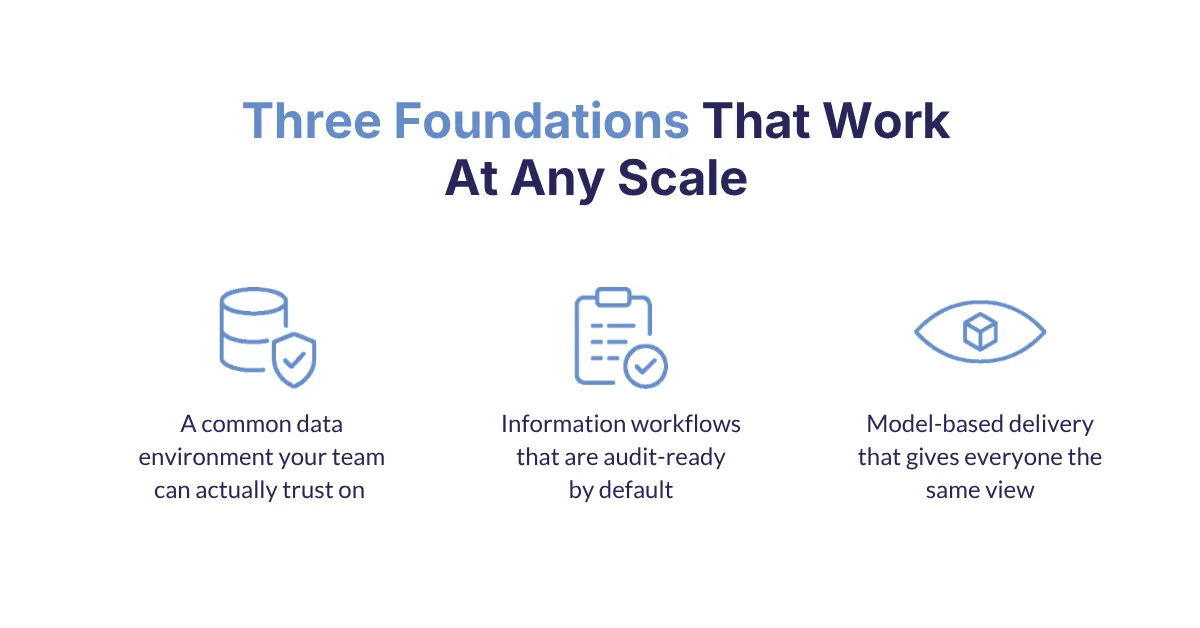
- A common data environment your team can actually trust on
Most teams already have a CDE in some form. Yet many still store information on network drives or send files by email, which undermines the whole point of having one.
The purpose of a CDE doesn’t change with project size. It’s there to give the team a trusted source of information. On major projects, that means an ecosystem of connected platforms, structured classification, and access controls across multiple organisations. On a smaller project, a single CDE with a simple structure, fit-for-purpose metadata, version control, and permissions can deliver the same outcome. The goal is a governed, repeatable, and trusted project environment; however it’s achieved.
- Information workflows that are audit-ready by default
Once you know where information lives, the next question is how it moves. Information needs to be reviewed, approved, exchanged, and governed in a controlled and repeatable way.
On major projects, this often follows formal frameworks such as ISO 19650, with clearly defined responsibilities and multi-discipline approvals. The concept that matters most is being audit-ready by default. Teams should be able to show what information was delivered, when, who approved it and whether it met requirements, without having to rebuild that history after the fact.
Smaller teams can apply the same idea through simple review and approval processes and basic governance controls. The result is information that’s structured, searchable, and trusted.
- Model-based delivery that gives everyone the same view
A model is a digital representation of the project. Brenton has seen it communicate complex ideas more clearly than drawings often can, especially between disciplines that usually speak different languages.
On many projects, models are mainly used for visualisation and design development. As complexity grows, they become a central coordination tool. Disciplines contribute to a federated model, and teams can identify clashes and resolve them before they become construction problems.
The aim isn’t the highest level of modelling detail possible. It’s using the model in a way that improves collaboration and understanding, so every stakeholder is looking at the same thing when decisions get made.
The goal isn’t maximum digital maturity
Knowing the foundations is one thing but knowing how far to take them is another.
A common misconception is that every organisation should be aiming for the highest possible level of digital maturity. Major infrastructure projects often set the benchmark, with strict metadata, formal information states, structured exchanges and sophisticated approval workflows.
But major projects aren’t successful because they use more technology. It’s often the philosophy behind it that drives their success. And what works on a major project won’t automatically translate to a smaller project or a smaller team. Scale applies to the project, the size of the team, and the maturity of the business.
Brenton suggests thinking about it in three levels:
| Level | Typical project | What changes |
|---|---|---|
| Bronze Level 1 | Smaller projects, smaller teams, lower risk | A CDE, information management and modelling are all in place, with light governance and coordination |
| Silver Level 2 | More complex projects | Metadata matters more, workflows become formalised, and models become a coordination tool |
| Gold Level 3 | Major infrastructure programs | Information moves between multiple organisations and systems, exchange is highly structured, and models become a delivery asset through to handover |
The key point is that none of these levels are a measure of success. A bronze project can be every bit as successful as a gold one. Problems start when the levels are mismatched.
“A gold implementation on a bronze-level project is where we can create unnecessary overhead,” Brenton said. Applying a full ISO 19650 workflow to a project that just needs a review, and an approved date only weighs the team down. The principles stay the same. What changes is the level of control, governance and coordination applied to support them.
Start with the challenge, not the level
So how do you know which level your project needs?
Brenton’s advice is not to start with the label at all. Instead of deciding you want to be bronze, silver or gold, start with the problem you’re trying to solve. Then work out which tools and practices can be scaled to address it and do that together with the people who face those challenges every day.
The same applies to smaller projects. A team whose modelling covers only the civil components is already building the foundations of model-based delivery. The opportunity is to find the challenges they’d like to solve next and scale up from there, rather than waiting for a major project to start.
Beyond the three foundations, there’s plenty more teams can explore as they mature. That includes structured information standards, requirements and compliance management, automation, system integration, and preparing information for handover. The same rule applies to all of them: pick what delivers real benefit, then scale it to the outcomes your project, organisation and client need.
It also takes honest collaboration. As authorities such as Transport for NSW and Queensland’s Department of Transport and Main Roads raise their digital requirements, Brenton sees the industry learning what those requirements mean in practice. That calls for open conversations between authorities, consultants and contractors about what’s needed, what can be delivered and what that will take, because none of this work is free.
Better decisions are the foundation
The lessons from major projects are valuable, but they aren’t a checklist to copy. They’re principles to scale. A trusted CDE, controlled information workflows, and model-based delivery can reduce risk and rework on projects of every size, as long as the level of control fits the project.
As Brenton put it, the successful management of information is the foundation of project delivery. Define it and automate it as efficiently as you can, and you create a process that’s reliable, repeatable and scalable. That frees your people to focus their talent on delivering quality outcomes.
Michael summed up where the real value lies. “The true value of digital delivery is not the models we create. It’s the decisions we improve, the risks we avoid, and the capability we leave behind.”
You've watched the full webinarWant to see how this works on your own projects?
Book a demo12d Synergy is an ISO 19650-compliant common data environment built for civil, infrastructure and surveying projects, and it scales from small teams to major programs. [Talk to our team] to find out how it can support your project.

12d Synergy
Common Data Environment
Make project information easier to manage with 12d Synergy.
From documents and drawings to emails, models and workflows, 12d Synergy brings everything together in one secure system so your team can work more efficiently from day one.
Book a Demo