
The Data Disconnect: Hidden Costs of Poor Data Management
Understanding the Hidden Costs of Inefficient Data Management in Engineering and Construction
You just lost thousands of dollars this week.
Not on materials. Not on labor rates. Not on equipment delays.
You lost it on something far more insidious: the time your teams spent searching for the right version of a file, redoing work because someone had outdated data, and sitting in meetings trying to figure out why the survey data doesn’t match the design model.
According to research by Hexagon AB, approximately 32% of work hours on construction sites are wasted, spent idle or waiting due to a lag in materials or information delivery. For the European construction industry alone, the absence of correct data management costs EU firms £62.18 billion per year.
This guide shows you how to get it back by exploring how connected data environments like 12d Synergy deliver measurable returns across financial, operational, and strategic dimensions. Whether you’re a surveyor focused on field accuracy, a Digital Engineer coordinating complex models, or an executive evaluating technology investments, you’ll find quantifiable insights into how modern data management transforms project outcomes.
Make project information easier to manage with 12d Synergy.
From documents and drawings to emails, models and workflows, 12d Synergy brings everything together in one secure system so your team can work more efficiently from day one.
Book a DemoThe Cost of Inefficient Data Management
The Hidden Tax on Every Project
Data inefficiencies represent one of the largest yet most overlooked drains on AEC project profitability. While teams focus on equipment costs and labour rates, traditional approaches to data management in construction were inefficient, error-prone, and not conducive to collaboration across distributed stakeholders.
According to FMI Corporation, more than $177 billion is lost each year in the U.S. construction industry due to inefficiencies like rework, time spent searching for data and communication breakdowns.
Real world challenges include:
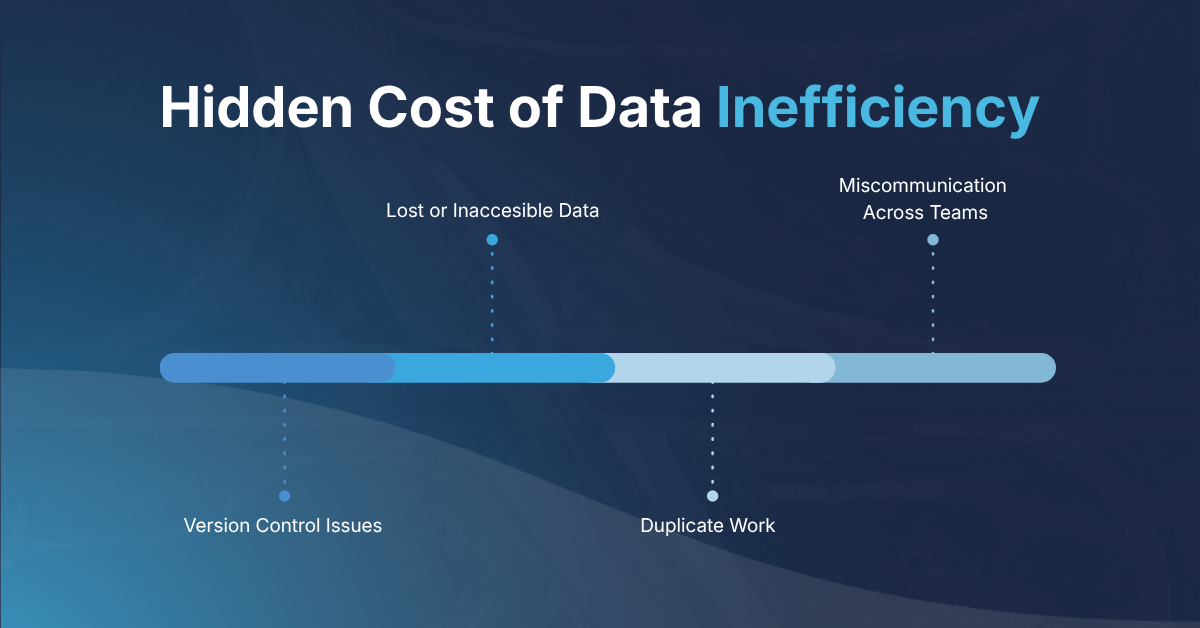
Version Control Issues
Multiple team members working on outdated files creates a cascade of problems. A surveyor uploads field data, but the design team works from yesterday’s model. By the time the discrepancy is discovered, hours of design work must be redone.
Lost or Inaccessible Data
Critical survey points stored on a technician’s laptop. As-built information buried in email threads. Project data scattered across multiple platforms requiring manual consolidation.
FMI’s research shows that construction professionals spend more than 14 hours per week on non-optimal tasks; things like searching for files, resolving formatting issues, or reconciling outdated documents. That’s more than a third of the workweek lost to friction points outside of core design or delivery activity.
Duplicate Work
Without a single source of truth, teams unknowingly repeat work already completed. Surveyors re-measure previously captured points. Engineers recreate calculations because original files are inaccessible.
Miscommunication Across Teams
Field crews, designers, and contractors working from different data sets make decisions based on inconsistent information. This leads to coordination issues, site stoppages, and costly corrections.
According to analysis by MyComply, 48% of all construction rework is driven by poor collaboration, and 26% is linked directly to miscommunication. $31.3 billion in rework was caused by poor project data and miscommunication in the U.S. alone in 2018.
The Cost of Rework
Rework represents one of the most significant hidden costs in construction:
Across project types and regions, rework accounts for 1–20% of total project cost, with most studies clustering between 4–10%. The Construction Industry Institute (CII) and multiple peer-reviewed studies confirm that even modest percentages translate to billions in lost project value globally (Source).
Overall, rework in construction projects often costs around 5% of the total project cost. The worst part is that the overruns compose approximately 7.1% of overall work hours. (Source)
According to industry research, rework contributes to an average of 52% of total cost growth in construction projects and is responsible for schedule overruns of up to 22%. (Source)
Where Does Rework Come From?
Up to 70% of all rework in construction can be traced back to engineering and design related errors. Another study determined that almost 80% of cost deviations on projects are related to design, while only 17% are related to construction activities.
About 30% of the work done at construction sites is actually rework, requiring a substantial amount of time.
ROI of Connected Data Environments
When looking at the financial impact of implementing connected Common Data Environments, here are the numbers to consider from industry research and real-world implementations:
Financial ROI: Direct Bottom-Line Impact
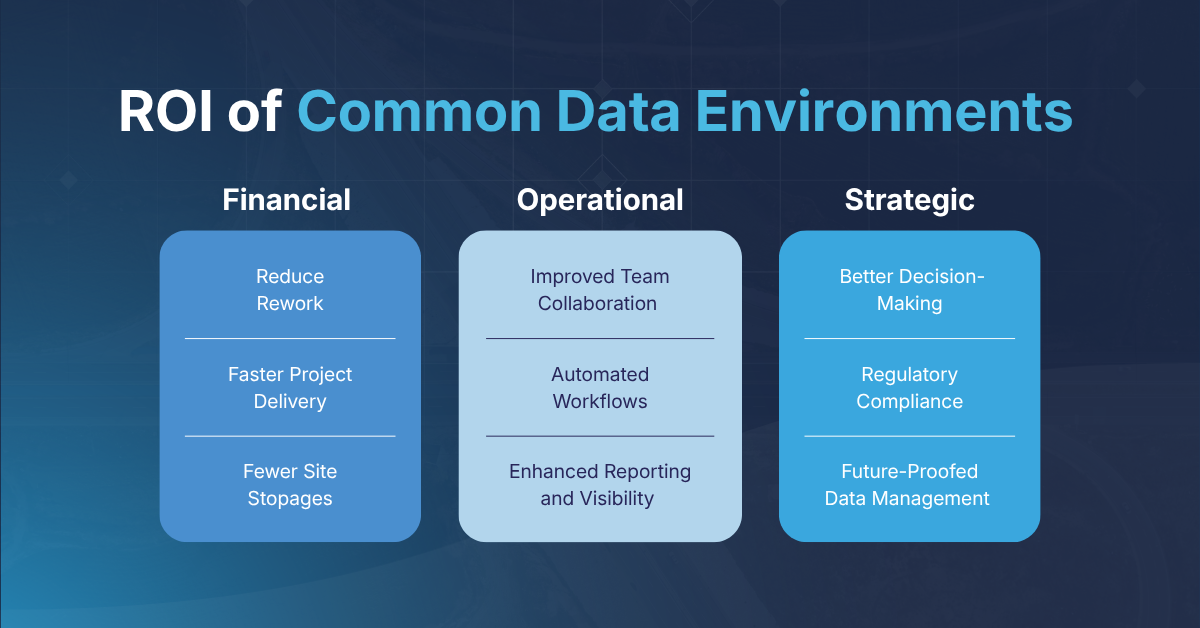
Reduced Rework and Errors
Connected data environments eliminate the root causes of costly rework. When all team members access the same current data, design conflicts are caught early, field measurements integrate seamlessly into models, and coordination issues are resolved before they reach the construction site.
Based on rework typically costing 4-10% of total project costs, connected data environments have demonstrated the ability to significantly reduce these issues, delivering substantial savings on mid-sized to large projects.
Faster Project Delivery
Real-time data synchronisation accelerates every project phase. Survey data flows directly into design models. Design changes immediately visible to all stakeholders. Approvals processed faster with complete, accurate information.
Fewer Site Stoppages
Site delays due to data discrepancies or missing information represent some of the most expensive project disruptions. Connected workflows ensure field teams always have current information, dramatically reducing data-related site delays.
Operational ROI: Efficiency and Productivity Gains
Improved Team Collaboration
Breaking down data silos transforms how teams work together. Surveyors, designers, and engineers collaborate in real-time rather than through slow file exchange cycles, leading to substantial improvements in coordination efficiency and cross-team communication.
Automated Workflows
Manual data transfers, format conversions, and file management consume enormous time. Automated workflows eliminate these repetitive tasks.
With technical report management systems, some AEC companies have reduced report development time by up to 70% and received an increase of up to 50% in report approvals on the first submission.
Enhanced Reporting and Visibility
Real-time project dashboards and automated reporting give stakeholders unprecedented visibility into project status, data quality, and team productivity, enabling faster issue identification and improved resource allocation.
Strategic ROI: Long-Term Competitive Advantage
Better Decision-Making
Access to current, accurate data enables faster, more confident decisions at every project level. When teams work from a single source of truth, decisions are based on the same information, reducing conflicts, and eliminating the delays caused by data discrepancies. From field adjustments to project planning, having reliable data reduces risk and improves outcomes.
Regulatory Compliance: ISO 19650
ISO 19650 is a series of standards that provides guidelines and requirements for the organisation and management of information within the construction industry, specifically for Building Information Modelling (BIM). These standards are designed to ensure consistency, security and interoperability in BIM processes and data exchange on a global scale.
Implementing ISO 19650 standards provides a wide range of operational and strategic advantages including cost reduction via minimised rework and more efficient information exchange, improved collaboration across organisational and disciplinary boundaries, heightened project predictability thanks to standardised workflows and deliverables, a lower number of legal disputes made possible by better documentation, and streamlined handover processes between project phases.
Future-Proofed Data Management
The construction industry is undergoing a once-in-a-generation transformation. What was once a fragmented, manual, and inefficient process is becoming smarter, faster, and more connected. The trends shaping 2026, including AI-driven automation, digital twins, modular construction, and cloud-based workflows, aren’t just innovations; they are completely reshaping the DNA of AEC.
Investment in connected data infrastructure positions organisations for emerging technologies like AI, digital twins, and predictive analytics.
Calculate Your Specific ROI
Understanding Your Current State
The data management challenges facing your projects are unique to your team size, project types, and current workflows. Before you can calculate potential savings, you need to first quantify your current inefficiencies.
According to research by FMI Corporation, construction professionals spend more than 14 hours per week on non-optimal tasks (FMI Corporation)—things like searching for files, resolving formatting issues, or reconciling outdated documents. That’s more than a third of the workweek lost to friction points outside of core design or delivery activity.
But every organisation is different. Your specific costs depend on:
- Team size – How many people regularly work with project data
- Current inefficiencies – Time lost to searching, version conflicts, rework, and manual processes
- Hourly costs – Your fully-loaded labour rates including salary, benefits, and overhead
- Project complexity – Types of projects and coordination requirements
How Our ROI Assessment Works
Our team uses a comprehensive ROI assessment tool to help you understand both the problem and the opportunity:
Step 1: Quantify Your Current Costs
Step 2: Identify Your Savings Potential
Step 3: Calculate Your Specific ROI
Ready to See Your Numbers?
Our ROI assessment typically takes 30 minutes and provides immediate insights into your potential savings.
Next Steps: Transform Your Data Workflows
The Digital Transformation Imperative
The global market for Architectural, Engineering, and Construction (AEC) was estimated to be worth USD 10.05 billion in 2023. From 2024 to 2032, the market is expected to develop at a compound annual growth rate (CAGR) of 10.3%, with a target value of USD 24.36 billion at the conclusion of the forecast period. (Source)
The AEC industry has operated in a highly complex, fragmented, and project-based manner for decades, with numerous stakeholders involved at every step, leading to interface frictions and inefficiencies. However, the AEC landscape is rapidly changing, with new trends and technologies reshaping the way buildings and civil projects are designed, built, and managed.
The firms that embrace connected data environments now will be the ones that thrive in this transformed landscape.
Why Act Now?
Every week of delay represents continued losses:
- Teams wasting hours on preventable data issues
- Projects experiencing avoidable rework and delays
- Opportunities lost to more digitally mature competitors
- Compliance requirements becoming more stringent
The opportunity cost compounds with every project.
All statistics and claims in this guide are supported by peer-reviewed research, industry studies, or verified client data. ROI calculations should be considered estimates for planning purposes and may vary based on organizational factors, implementation approach, and current workflows.
Request Your ROI Assessment

12d Synergy
Common Data Environment
Make project information easier to manage with 12d Synergy.
From documents and drawings to emails, models and workflows, 12d Synergy brings everything together in one secure system so your team can work more efficiently from day one.
Book a Demo